Site Selection for AI Data Centers: Power, Climate, and Connectivity Considerations
Reading time: 7 min read | Published: October 21, 2026 | Category: Data Center Infrastructure
In this article:
Key Takeaways · Power: The Non-Negotiable Foundation · Climate and Cooling Architecture · Network Connectivity · Regulatory and Community Factors · A Site Evaluation Framework · Explore Further
Key Takeaways
- Power availability is the primary constraint for AI data center siting — a 100MW+ campus requires utility-scale electrical infrastructure that is available at fewer locations than most operators initially assume, according to Uptime Institute's 2025 capacity analysis.
- Cooling architecture determines climate sensitivity — air-cooled facilities are constrained to cooler climates, while hydro-cooled systems operate effectively across the full range of global climate conditions.
- Network latency requirements vary dramatically by workload type — AI training clusters tolerate higher latencies than inference serving, enabling training facilities to be sited further from population centers where power is cheaper.
- Regulatory environment increasingly determines project viability — permitting timelines, water rights, noise ordinances, and ESG reporting requirements vary by jurisdiction and can add 6–18 months to deployment schedules.
Power: The Non-Negotiable Foundation
Every data center site decision begins with power. AI training clusters consume power at densities and scales that are historically unprecedented outside of industrial manufacturing. A single rack of NVIDIA GB200 NVL72 systems draws approximately 120kW. A training cluster of 10,000 GPUs — a modest scale by 2026 standards — requires 15–20MW of IT power, plus cooling and distribution overhead.
The critical factors in power evaluation are:
Available capacity. The site must have access to sufficient electrical capacity on the local transmission or distribution grid. This is not simply a matter of total grid capacity — the specific substation, transmission lines, and interconnection points serving the site must have available headroom. In many markets, 50MW+ capacity at a single point of connection requires utility coordination 12–24 months in advance, as documented by the U.S. Department of Energy's transmission capacity analysis.
Cost. Electricity cost varies by a factor of 5–10x across commercially viable markets. Industrial power rates range from $0.02–0.03/kWh in parts of the Middle East, Central Asia, and Scandinavia to $0.10–0.15/kWh in tier-1 markets like Northern Virginia, Singapore, and Tokyo. For a 50MW facility, a $0.01/kWh difference in power cost represents approximately $4.4 million per year in operating expense.
Reliability. Grid reliability metrics — System Average Interruption Duration Index (SAIDI) and System Average Interruption Frequency Index (SAIFI) — vary significantly by region. For AI training workloads, where a power interruption can destroy days of computation, high grid reliability reduces the required investment in on-site backup generation and UPS capacity.
Renewable energy access. Proximity to renewable energy sources (solar, wind, hydro) or the availability of renewable power purchase agreements (PPAs) is increasingly a requirement for corporate and hyperscale operators committed to carbon neutrality. Sites with direct access to renewable generation — such as co-location with solar farms or hydroelectric facilities — offer both cost and ESG advantages.
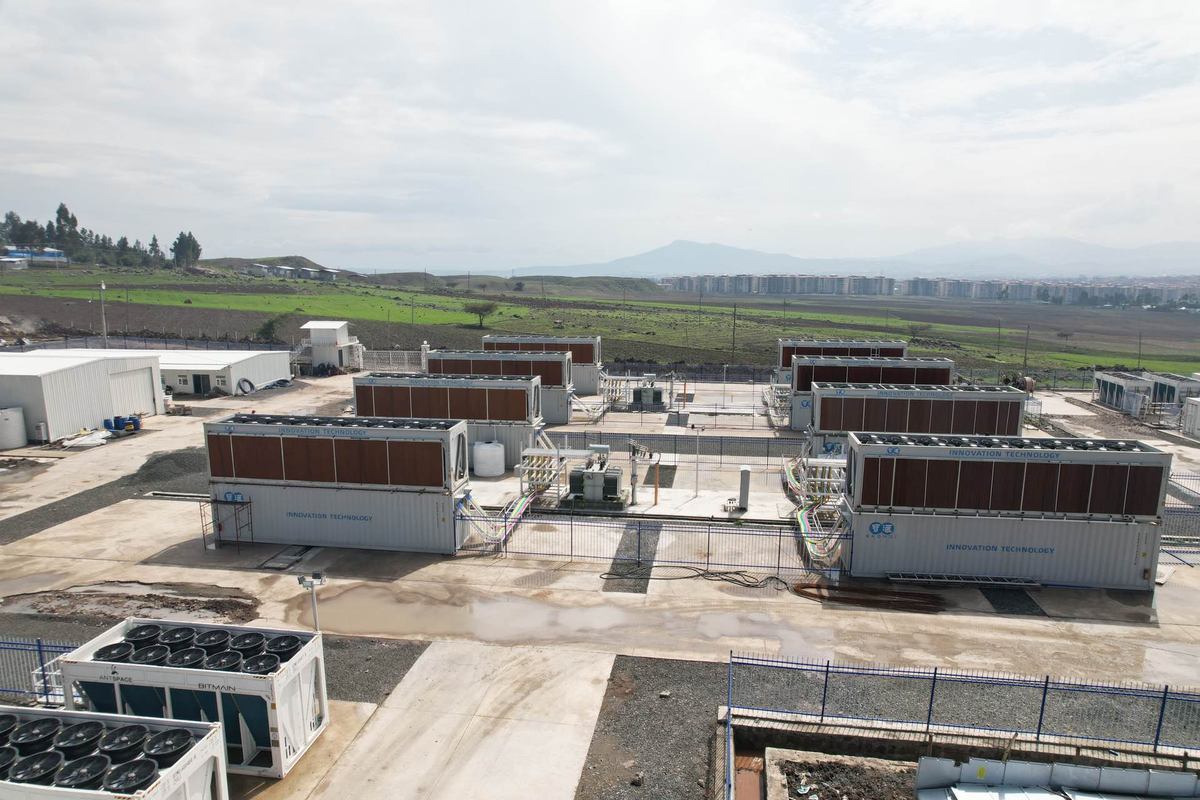
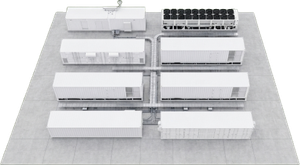
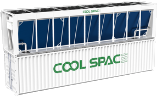
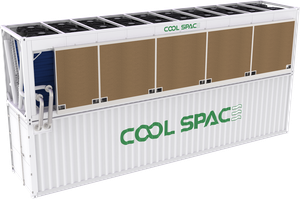
A multi-megawatt containerized data center campus — site selection for deployments at this scale requires careful evaluation of power, cooling, connectivity, and regulatory factors.
Climate and Cooling Architecture
Climate conditions at the site determine the range of viable cooling architectures and, by extension, the facility's operating costs and water consumption profile.
Cool and temperate climates (annual average temperature below 15°C). These locations — Northern Europe, Canada, parts of Japan, and the Pacific Northwest — support air-side economization for a significant portion of the year, reducing mechanical cooling requirements. They are also favorable for dry cooler performance in hydro-cooled systems, as the larger temperature differential between coolant and ambient air improves heat rejection efficiency.
Hot and arid climates (annual average temperature above 25°C, low humidity). The Middle East, parts of Africa, and the American Southwest. Air cooling is energy-intensive and may be impractical for high-density racks. Evaporative cooling is effective but consumes large quantities of water — a critical consideration in water-stressed regions. Closed-loop hydro-cooling with oversized dry coolers is the preferred approach, eliminating water consumption while managing the higher ambient temperatures.
Hot and humid climates (annual average temperature above 25°C, high humidity). Southeast Asia, coastal regions. Both air cooling and evaporative cooling face challenges — high humidity limits evaporative efficiency, and high wet-bulb temperatures reduce the effectiveness of cooling towers. Closed-loop hydro-cooling with dry coolers remains effective, as the system is insensitive to humidity.
The key insight is that hydro-cooling with dry coolers decouples site selection from climate constraints. While air-cooled and evaporative-cooled facilities are limited to locations with favorable climate profiles, hydro-cooled systems operate effectively across the full range of global climate conditions, expanding the pool of viable sites to include locations with the lowest power costs.
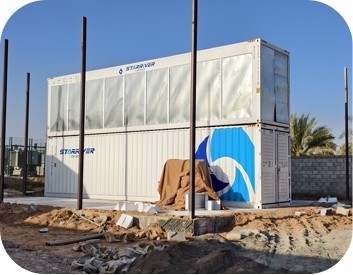
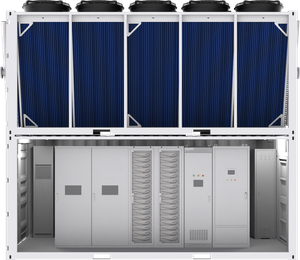
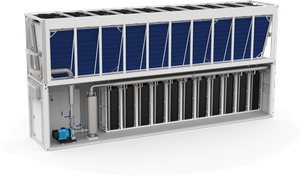
A CoolSpace containerized unit deployed in the field — hydro-cooled systems operate reliably in ambient temperatures from -40°C to +55°C, enabling site selection based on power cost rather than climate.
Network Connectivity
Network requirements for AI data centers differ significantly from traditional enterprise or cloud deployments:
AI training. Training clusters are internally network-intensive (high-bandwidth GPU-to-GPU communication via InfiniBand or RoCE) but relatively tolerant of external latency. The training data pipeline can tolerate 10–50ms of latency to storage systems, and the trained model output is a relatively small data object. This means training facilities can be sited at locations with moderate (not ultra-low-latency) external connectivity — enabling selection of remote sites with lower power costs.
AI inference. Inference serving — running trained models against real-time user queries — is latency-sensitive. Response time budgets of 50–200ms for end-user applications require inference infrastructure to be located within low-latency reach of the user population. This typically means deployment in or near major metropolitan areas, at sites with direct fiber connectivity to internet exchange points (IXPs).
Hybrid architectures. Many operators deploy training infrastructure at cost-optimized remote locations and inference infrastructure at latency-optimized urban or edge locations. The trained models are transferred between facilities as needed — a process that is bandwidth-intensive but infrequent, and can be scheduled during off-peak hours.
Regulatory and Community Factors
Regulatory environment can add 6–18 months to a project timeline or block it entirely. Key factors include:
- Permitting timelines: Building permits, electrical permits, environmental impact assessments, and water use permits vary from weeks (in data-center-friendly jurisdictions) to 12+ months (in jurisdictions with complex approval processes).
- Noise regulations: Air-cooled data centers generate 80–95 dBA at the perimeter. Many jurisdictions enforce 55–65 dBA limits at property boundaries. Hydro-cooled facilities typically meet noise requirements without additional mitigation, as reported by IEA infrastructure assessment.
- Water rights: In water-stressed regions, securing water rights for evaporative cooling systems can be difficult or impossible. Closed-loop hydro-cooling eliminates this constraint entirely.
- Tax incentives: Several jurisdictions offer tax abatements, accelerated depreciation, or direct subsidies for data center development, particularly in areas seeking technology industry investment. These incentives can reduce total cost of ownership by 10–20% over a 10-year horizon.
A Site Evaluation Framework
Operators evaluating potential sites should score each candidate across five dimensions, weighted by their specific operational priorities:
- Power (35–40% weight): Available capacity, cost per kWh, grid reliability metrics, renewable energy access, and utility cooperation timeline.
- Cooling feasibility (20–25% weight): Climate profile, water availability, cooling architecture options, and resulting PUE/WUE projections.
- Connectivity (15–20% weight): Fiber availability, latency to target markets, IXP proximity, and carrier diversity.
- Regulatory (10–15% weight): Permitting timeline, environmental requirements, noise restrictions, tax incentives, and political stability.
- Operational (10% weight): Workforce availability, access logistics, security, and natural disaster risk profile.
Explore Further
CoolSpace's modular hydro-cooled infrastructure is designed for deployment across the full range of global climate conditions and site types — from urban edge locations to remote power-optimized campuses. The containerized form factor enables rapid deployment regardless of site infrastructure maturity.
Explore the full product range at coolspacehk.com/products or contact the engineering team to discuss site-specific requirements for your next deployment.
Follow CoolSpace: LinkedIn · News & Updates

 AI Data Centers
 Crypto Infrastructure