Home / All

Blog

  • Cold-Plate Liquid Cooling vs. Immersion Cooling: How to Choose
    Cold-Plate Liquid Cooling vs. Immersion Cooling: How to ChooseOct 28,2026
    Cold-plate liquid cooling and immersion cooling solve the same heat problem in different ways. This guide compares server compatibility, serviceability, facility design, water use and operations to help data-center teams choose the right architecture.
  • Rack Density: From 10 kW to 100 kW
    Rack Density: From 10 kW to 100 kWOct 23,2026
    AI accelerator power per device has increased roughly 5x in four years — from the 300W TDP of NVIDIA's A100 in 2020 to the 1,000W+ envelope of the B200 and GB200 NVL configurations shipping in 2025–2026, according to NVIDIA's published specifications. Traditional air-cooled facilities hit a practical thermal ceiling around 15–20kW per rack, forcing operators deploying next-generation AI training clusters to re-evaluate their entire cooling architecture. Hydro-cooling systems can support rack den
  • AI Data Center Site Selection
    AI Data Center Site SelectionOct 21,2026
    Choosing the right site for an AI data center requires balancing power availability, cost, and reliability with climate conditions, network connectivity, and regulatory environment. This guide examines the critical factors that determine whether a site can support high-density AI compute infrastructure at scale.
  • Direct-to-Chip Cooling: A Technical Guide
    Direct-to-Chip Cooling: A Technical GuideOct 19,2026
    Direct-to-chip (D2C) cooling delivers coolant directly to GPU and CPU heat sources through precision cold plates, enabling rack densities of 80-120kW while maintaining chip junction temperatures 20-30°C below air-cooled levels. This technical guide covers the engineering, deployment, and operational considerations.
  • Water Usage Effectiveness (WUE) Explained
    Water Usage Effectiveness (WUE) ExplainedOct 16,2026
    While PUE measures energy efficiency, Water Usage Effectiveness (WUE) measures how much water a data center consumes per kilowatt-hour of IT energy. As regulatory scrutiny intensifies and water scarcity becomes a global concern, WUE is emerging as the next critical metric for data center operators and investors.
  • Liquid Cooling for High-Density Mining Operations
    Liquid Cooling for High-Density Mining OperationsOct 14,2026
    Mining profitability is determined as much by cooling infrastructure as by hashrate. Hydro-cooled mining operations achieve 15-30% lower energy costs per terahash while extending ASIC hardware lifespan by reducing thermal stress. This guide examines the engineering and financial case for hydro-cooling in mining at scale.
  • Modular Data Centers for AI Deployment
    Modular Data Centers for AI DeploymentOct 12,2026
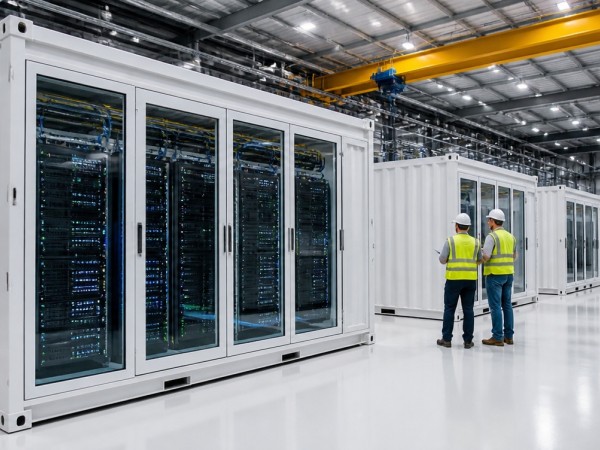
    Modular prefabricated data centers reduce deployment timelines from 18 months to as little as 8 weeks while delivering higher power density per square meter. As AI workload demand outpaces traditional construction, factory-built containerized solutions offer a faster, more cost-effective path to operational capacity.
  • Understanding PUE in Data Center Operations
    Understanding PUE in Data Center OperationsApr 11,2026
    Power Usage Effectiveness — PUE — is a standard metric in data center operations that quantifies how efficiently a facility uses energy. For high-density compute data center operations running at megawatt scale, the difference between a PUE of 1.4 and 1.08 is not an abstract efficiency figure. This article explains how PUE is calculated, what drives it in data center environments, and why cooling architecture is the primary lever available to operators seeking to improve it.
  • Air vs Liquid Cooling for High-Density Data Centers
    Air vs Liquid Cooling for High-Density Data CentersApr 10,2026
    This article examines the engineering differences between air cooling and hydro cooling in high-density ASIC deployments — covering heat dissipation capacity, operational stability, energy efficiency, and long-term infrastructure scalability. For operators evaluating cooling architecture for new or expanding high-density compute data centers, understanding these differences has direct implications for uptime, hardware longevity, and cost of operation.
  • Liquid-Cooled Data Centers in Extreme Environments
    Liquid-Cooled Data Centers in Extreme EnvironmentsApr 9,2026
    This article outlines the key infrastructure considerations for high-density compute data center operators targeting non-standard sites — covering thermal management under extreme ambient conditions, power infrastructure in grid-constrained locations, logistics for containerized deployment, and the operational factors that determine whether a challenging site can be made to perform reliably at scale.

    Are you looking for a reliable supplier of cooling systems for large-scale hydro-cooling data center cluster?

    We can quickly provide customers with market analysis, technical support and customized services.