From 10kW to 100kW Per Rack: How Next-Generation AI Accelerators Are Redefining Data Center Thermal Limits
Reading time: 6 min read | Published: October 23, 2026 | Category: Data Center Infrastructure
In this article:
Executive Summary · The Power Density Trajectory · The 20kW Thermal Wall · Why Hydro-Cooling Is the Engineering Answer · Real-World Deployment Considerations · The Financial Case for Early Transition · Future-Proofing for 2027 and Beyond · Explore Further
Executive Summary
- AI accelerator power per device has increased roughly 5x in four years — from the 300W TDP of NVIDIA's A100 in 2020 to the 1,000W+ envelope of the B200 and GB200 NVL configurations shipping in 2025–2026, according to NVIDIA's published specifications.
- Traditional air-cooled facilities hit a practical thermal ceiling around 15–20kW per rack, forcing operators deploying next-generation AI training clusters to re-evaluate their entire cooling architecture.
- Hydro-cooling systems can support rack densities of 50–100kW or higher while maintaining PUE values below 1.15 under typical operating conditions, as documented in Uptime Institute research.
- Retrofitting air-cooled facilities for high-density AI workloads typically costs 40–60% more than purpose-built hydro-cooled deployments, making the transition a financial decision as much as a technical one.
The Power Density Trajectory: A Hardware Problem Becoming an Infrastructure Crisis
The trajectory of AI accelerator power consumption tells a clear story. NVIDIA's data center GPU lineup has progressed from the A100 at 300W TDP to the H100 at 700W, then to the B200 at approximately 1,000W, and now the GB200 NVL72 system — a full-rack configuration that draws roughly 120kW for 72 GPU units in a single dense enclosure. AMD's Instinct MI300X series operates in a similar power envelope, and custom silicon from hyperscalers is following the same curve.
This is not a temporary spike. The relationship between model parameter count and required compute is well-documented in scaling laws research. As AI models continue to grow — with frontier models now exceeding a trillion parameters — the silicon required to train and serve these models must operate at higher clock speeds, wider memory bandwidths, and greater transistor densities. All of these factors produce more heat per unit of silicon area.
The consequence for data center operators is straightforward: the thermal load per square meter of data hall floor space is increasing faster than traditional cooling architectures can accommodate. According to the ASHRAE TC 9.9 guidelines for data center thermal management, the recommended inlet air temperature range for IT equipment is 18–27°C. Maintaining this range with air alone becomes exponentially more expensive — and eventually physically impossible — as rack densities climb past 20kW.
The 20kW Thermal Wall: Why Air Cooling Runs Out of Physics
Air, as a heat transfer medium, has fundamental physical limitations. Its volumetric heat capacity is approximately 1.2 kJ/(m³·K) at standard conditions, compared to roughly 4,180 kJ/(m³·K) for water — a factor of about 3,500x. This means that removing the same amount of heat energy requires vastly more airflow volume than water flow, which translates directly into larger fans, more ductwork, greater floor space, and higher energy consumption for the cooling system itself.
In practice, well-designed air-cooled data centers can effectively handle rack power densities up to roughly 15–20kW. Beyond this threshold, several compounding problems emerge:
- Hot spots and thermal stratification: High-velocity air cannot distribute evenly across densely packed server components, creating localized overheating that triggers thermal throttling and reduces compute output.
- Fan power consumption: Airflow requirements scale non-linearly with heat load. Doubling the rack power density can require four to eight times the fan energy, as documented in Lawrence Berkeley National Laboratory's data center efficiency research.
- Floor space penalty: Adequate hot-aisle/cold-aisle containment at high densities demands wider aisles and more CRAH/CRAC units, reducing the usable IT floor space per square meter of building.
- Noise and vibration: Server fan speeds at maximum thermal load create noise levels exceeding 85 dBA, posing occupational health constraints for maintenance staff under prolonged exposure.
For facilities planning to deploy racks at 40kW, 60kW, or the 100kW+ densities that next-generation GPU clusters require, air cooling is not merely inefficient — it is architecturally inadequate.
Why Hydro-Cooling Is the Engineering Answer
Hydro-cooling — the use of water or water-glycol mixtures circulated through direct-to-chip cold plates, rear-door heat exchangers, or immersion tanks — addresses the fundamental physics limitation by using a medium with dramatically superior thermal properties.
The advantages at high rack densities are measurable and well-characterized:
- Thermal capacity: Water removes heat approximately 3,500 times more efficiently by volume than air, enabling compact cooling loops that serve 100kW+ racks within the same physical footprint as a traditional 10kW air-cooled rack.
- PUE improvement: Facilities using closed-loop hydro-cooling systems routinely achieve PUE values between 1.05 and 1.15 under free cooling conditions, compared to 1.3–1.6 for comparable air-cooled facilities. This translates directly to lower operating costs per kilowatt of IT load. The International Energy Agency's data center analysis highlights cooling efficiency as the primary lever for reducing total facility energy consumption.
- Precision temperature control: Hydro-cooling maintains chip junction temperatures within a tighter band (typically ±2°C), which can extend hardware lifespan and enable sustained boost clock frequencies that air-cooled systems cannot maintain under load.
- Noise reduction: Eliminating or greatly reducing server fan speeds in hydro-cooled configurations drops data hall noise levels below 65 dBA, improving working conditions for operations staff.
These are not theoretical projections. Major cloud providers and AI training companies — including those operating GPU clusters in excess of 10,000 accelerators — have publicly confirmed their transition to hydro-cooling architectures for next-generation deployments.
Real-World Deployment Considerations
Transitioning to hydro-cooling introduces engineering and operational considerations that operators should evaluate methodically:
Leak detection and containment. Modern hydro-cooling systems incorporate multi-zone leak detection sensors, drip trays, and automatic isolation valves. The statistical failure rate for welded cooling manifolds in enterprise environments is extremely low, and industry adoption over the past decade has produced well-tested mitigation protocols. The Open Compute Project's advanced cooling specifications provide standardized design guidance for leak-safe deployments.
Water treatment and quality. Closed-loop systems require water quality management — pH monitoring, biocide treatment, and filtration — to prevent corrosion and biological growth. These are standard practices in industrial cooling and HVAC systems, well-understood by mechanical engineering teams.
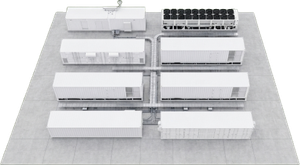
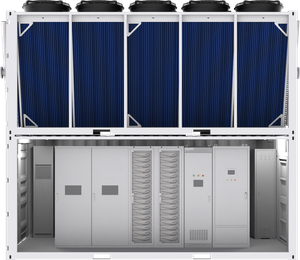
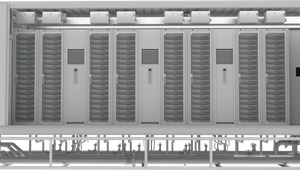
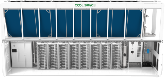
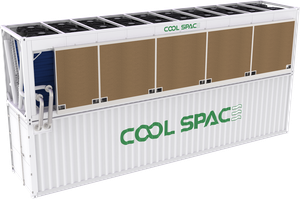
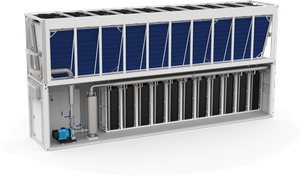
Modular and pre-fabricated deployment. One of the most significant developments in data center construction is the shift toward modular, factory-built cooling enclosures that arrive on-site fully tested and commissioned. This approach reduces deployment timelines from 18–24 months for traditional stick-built facilities to as little as 8–12 weeks for modular hydro-cooled units. CoolSpace's containerized solutions — including the CoolBase-1080A/W — are engineered specifically for this rapid-deployment model, integrating server racks, hydro-cooling loops, power distribution, and fire suppression into a single transportable unit.
Existing facility retrofits. Not every operator is building greenfield. For existing air-cooled facilities, rear-door heat exchangers (RDHx) offer a phased migration path: they replace the rear door of standard server racks with a water-cooled heat exchanger, capturing 60–80% of the rack's heat output without modifying the server hardware. This allows incremental densification from 10–15kW to 30–40kW per rack within the existing data hall footprint.
The Financial Case for Early Transition
The economics of hydro-cooling have shifted decisively in its favor as rack densities increase. A total cost of ownership (TCO) analysis for a 10MW AI training facility illustrates the scale of difference:
- Capital expenditure: A purpose-built hydro-cooled facility at 60kW per rack requires approximately 40% fewer racks, 50% less floor space, and proportionally less building infrastructure than an air-cooled facility delivering the same total IT load at 15kW per rack.
- Energy cost: At a PUE of 1.10 versus 1.45 (hydro-cooled vs. air-cooled), the hydro-cooled facility saves approximately 3.5MW of cooling overhead on a 10MW IT load. At an electricity rate of $0.08/kWh, this represents annual savings exceeding $2.4 million.
- Water cost: Closed-loop hydro-cooling systems consume significantly less water than evaporative cooling towers used in many air-cooled facilities. The U.S. Department of Energy's water efficiency guidance notes that evaporative systems consume 1.8 liters per kWh of heat rejected, a cost avoided entirely by closed-loop designs.
- Speed to revenue: Modular hydro-cooled deployments that reach operational status 4–6 months faster than conventional builds generate earlier revenue from compute services — a financial advantage that compounds significantly at the multi-megawatt scale of AI training clusters.
Future-Proofing for 2027 and Beyond
The power density trajectory shows no sign of flattening. Industry roadmaps from major semiconductor manufacturers indicate that the next generation of AI accelerators — expected in 2027–2028 — will push per-device TDPs toward 1,500W, with rack-level configurations potentially exceeding 150kW. Facilities built today on air-cooled assumptions will face expensive and disruptive retrofits within 2–3 years.
Operators making infrastructure decisions today face a clear choice: build for current requirements with air cooling and accept the cost of a forced transition within a short horizon, or invest in hydro-cooling infrastructure that accommodates both current and projected thermal loads without architectural redesign.
The engineering data, the financial analysis, and the hardware roadmaps all point in the same direction. The transition from air to hydro-cooling is not a question of if — it is a question of whether the transition happens proactively, on favorable terms, or reactively, at a premium.
Explore Further
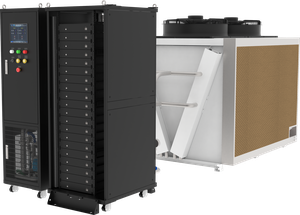
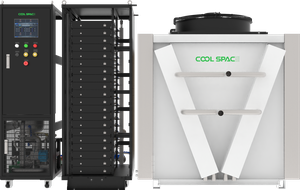
CoolSpace designs and manufactures modular hydro-cooling infrastructure purpose-built for high-density AI data center deployments, from single-rack solutions to multi-megawatt containerized systems. Explore the full product range — including the CoolBase-1080A/W and SR40 V3 Hydro Cooling Container — or contact the engineering team to discuss project-specific requirements.
Follow CoolSpace for the latest in data center infrastructure: LinkedIn · News & Updates

 AI Data Centers
 Crypto Infrastructure