Choosing between cold-plate liquid cooling and immersion cooling is rarely a question of which technology is better in the abstract. It is a question of which one fits the servers you plan to buy, the facility you can build, and the maintenance team you can staff. This article compares the two architectures on the points that most often decide real projects.
The short answer
Cold-plate liquid cooling (also called direct-to-chip cooling) circulates coolant through plates mounted on the hottest components, typically processors and accelerators. Immersion cooling submerges the entire server, or at least the whole board, in a dielectric fluid. Cold plates keep liquid away from most of the electronics and fit the server designs the market is already shipping. Immersion removes heat from every component, but it changes how hardware is built, serviced and procured.
For most new AI/HPC deployments planned around mainstream server platforms, cold-plate liquid cooling is the lower-friction path. Immersion can make sense when the operator controls the hardware specification and is ready to run a different maintenance model. The rest of this article explains why.
How each architecture works
Cold-plate liquid cooling
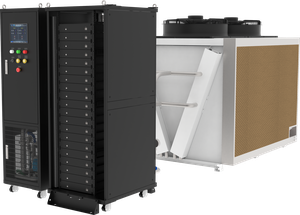
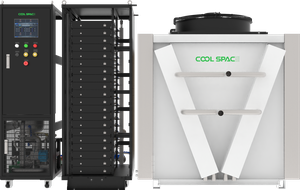
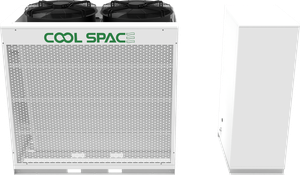
A cold plate is a metal block with internal channels, mounted directly on a chip. Coolant carries the heat out of the server to a manifold at the rack, and from there to a coolant distribution unit (CDU). The CDU separates the server-side loop from the facility loop through a heat exchanger and controls temperature, flow and pressure. Heat is then rejected through a dry cooler or other heat-rejection equipment.
Because plates cover only the highest-power parts, memory, storage, network cards and power delivery often still rely on some airflow. Many designs therefore remain hybrid: liquid for the processors, a smaller air path for everything else. For a deeper look at the engineering, see our technical guide to direct-to-chip cooling.
Immersion cooling
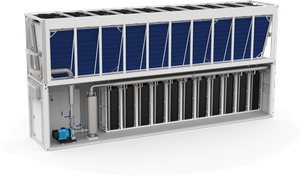
In single-phase immersion, servers sit in a tank of dielectric fluid that stays liquid. Pumps circulate the fluid through a heat exchanger. In two-phase immersion, the fluid boils at the heat source, and the vapor is condensed and returned, which requires sealed tanks. According to an immersion-cooling vendor's comparison, single-phase tanks operate at atmospheric pressure and cool the whole board evenly, while two-phase systems need hermetic tanks and careful flow management, and many two-phase fluids raise environmental and handling concerns.
Side-by-side comparison
| Factor | Cold-plate liquid cooling | Immersion cooling |
|---|
| Heat capture | Direct from processors and accelerators; other components may need air | From all submerged components |
| Server compatibility | Wide; many OEM platforms are offered with cold plates | Requires immersion-ready or modified hardware and warranty confirmation |
| Serviceability | Familiar rack workflow; quick-disconnect fittings at the server | Servers are lifted from fluid; cleaning and handling procedures required |
| Facility footprint | Fits standard rack layouts and containerized modules | Tank-based layouts; floor loading and fluid logistics need planning |
| Fluid considerations | Water-glycol or similar coolant in closed loops | Dielectric fluids; chemistry, vapor loss and disposal vary by type |
| Leak consequence | Coolant near electronics; mitigated by leak detection and quality fittings | Fluid is dielectric by design; containment and spill handling still apply |
| Residual air cooling | Often retained for non-plated components | Largely eliminated |
Decision criteria that matter most
1. Hardware strategy
Start with the server. If you plan to buy standard AI servers from major OEMs, confirm which are available with cold plates and which are qualified for immersion. Cold-plate options are widely offered; immersion qualification is narrower and must be verified model by model, including warranty terms. If you design or specify your own hardware, immersion becomes a realistic option.
2. Rack density and growth
Both approaches can address densities beyond what air cooling handles. The relevant question is what happens at the next hardware generation. Cold-plate systems scale by increasing coolant flow, upgrading manifolds and CDU capacity. Immersion scales by tank capacity and fluid-circulation capacity. Either way, size the facility loop and heat-rejection plant for the density you expect in three to five years, not only for day one. See our overview of rack density from 10 kW to 100 kW for the thermal context.
3. Operations and maintenance (O&M)
Operations and maintenance (O&M) cost is where the two diverge most in practice. Cold-plate racks follow workflows that data-center technicians already know: swap a server, reconnect, bleed air, verify flow. Immersion requires fluid handling, tank access procedures, component cleaning and different spare-parts logistics. Neither is inherently harder, but the training and procedures differ, so the staffing plan should be part of the technology decision.
4. Facility and deployment model
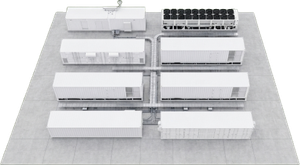
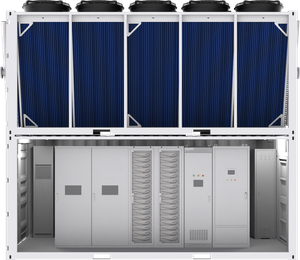
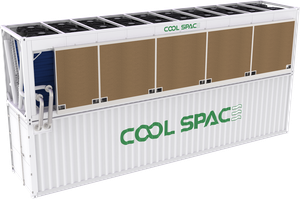
Cold-plate systems are well suited to modular and prefabricated deployments because the loop architecture (rack manifolds, CDUs, pipeline network, dry coolers) can be factory-built and tested as a unit. Immersion modules can also be prefabricated, but fluid supply, tank transport and on-site filling add steps worth scoping early.
5. Water and heat rejection
Both approaches can use closed facility loops and dry coolers, which limits water consumption. Warmer supply temperatures widen the hours a dry cooler can reject heat without evaporative assistance, but the allowable temperatures depend on the hardware vendor's specification. ASHRAE's guidance for liquid-cooled environments recommends separating the facility water system from the server-side loop with a CDU, adding thermal inertia and redundancy, and monitoring coolant quality, as summarized by DatacenterDynamics. Those principles apply to either architecture. For the metric side of this, read about Water Usage Effectiveness.
When each approach tends to fit
Cold-plate liquid cooling usually fits when:
- You are buying mainstream AI/HPC servers and want OEM support and warranty clarity.
- You want to reuse standard rack layouts, or deploy in containerized modules.
- Your technicians are experienced with conventional rack work.
- You need a clear path to higher densities by upgrading CDU and loop capacity.
Immersion cooling usually fits when:
- You specify or modify the hardware yourself.
- You want to remove nearly all server fans and residual air cooling.
- You can commit to new procedures for fluid handling and servicing.
- Your supplier can document fluid compatibility with every component in the server.
Hybrid facilities exist as well, with cold-plate racks for the densest compute and other methods elsewhere. The decision need not be all or nothing.
Questions to ask before you decide
- Which exact server models will we deploy, and are they offered and warrantied for this cooling method?
- What facility-water supply temperature does the hardware vendor specify, and what does that mean for our climate and heat rejection?
- What are the O&M procedures for replacing a failed component, and who will perform them?
- How will leaks, fluid loss or contamination be detected and handled?
- How will the cooling plant expand if rack density doubles?
- What does acceptance testing and commissioning look like for the complete loop?
Conclusion
Cold-plate liquid cooling and immersion cooling both solve the problem that air cannot: moving large amounts of heat out of compact, high-power hardware. The better choice is the one that matches your server roadmap, your site, and your operating team. For operators standardizing on mainstream AI servers and modular facilities, cold-plate liquid cooling generally offers the shorter path to deployment; for operators controlling their own hardware, immersion deserves a serious evaluation.
If you are comparing architectures for a specific project, the CoolSpace engineering team can discuss your load profile, climate and deployment model. Contact us to talk with an engineer, or review our comparison of air and liquid cooling for earlier-stage questions.

 AI Data Centers
 Crypto Infrastructure