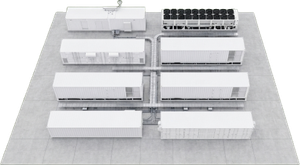
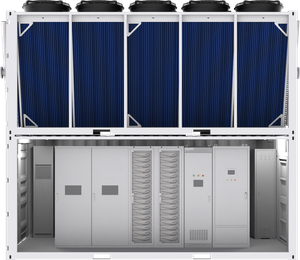
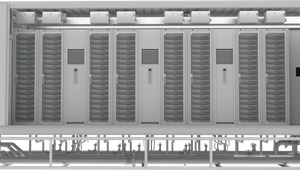
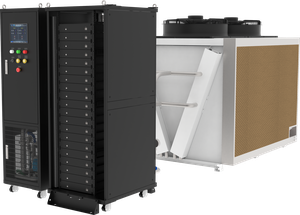
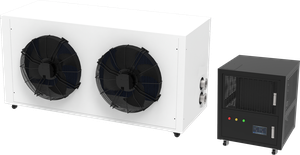
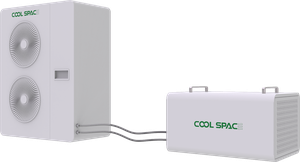
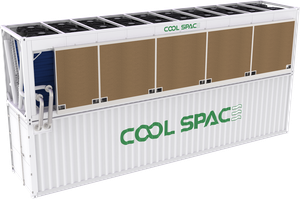
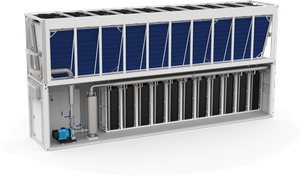
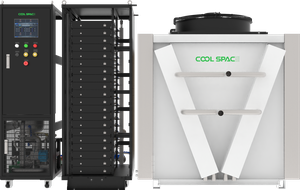
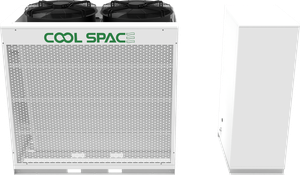
A coolant distribution unit (CDU) is the piece of equipment that lets a liquid-cooled data center move heat from servers to the outdoors without letting the two ends of the system touch. It keeps the clean, tightly controlled coolant that circulates through cold plates separate from the facility water that travels to dry coolers or chillers, and it controls the temperature, flow and pressure the IT equipment sees.
This article explains how a CDU does that job, what its main components are, how its capacity is rated, and what to look for when you review one for a project.
What a CDU does
In a direct-to-chip system, coolant flows through cold plates mounted on processors and accelerators, picks up heat, and returns to a central point. That central point is usually a CDU. Inside it, the warm coolant gives up its heat to a second water stream through a heat exchanger, then a pump sends the cooled coolant back to the racks.
A CDU therefore does four things at once:
- Isolates the IT loop from the facility loop, so contamination, pressure swings or chemistry problems on one side do not reach the servers.
- Transfers heat from the IT loop to the facility loop.
- Controls supply temperature, flow and differential pressure delivered to the rack manifolds.
- Protects the IT loop through filtration, expansion and makeup management, and monitoring.
Primary and secondary cooling loops
Most liquid-to-liquid CDU designs divide the system into two hydraulic circuits. Terminology varies between vendors and standards, so confirm how a supplier uses these terms before comparing documents.
The facility (primary) side
This loop carries heat from the CDU to the heat rejection equipment, such as dry coolers, adiabatic coolers or chillers. It is typically sized and managed by the facility design team, and it may serve many other loads besides the CDU.
The IT (secondary) side
This loop circulates conditioned coolant through the rack manifolds and cold plates. Because the cold-plate channels are very small, this side is kept clean, filtered and chemically controlled. The CDU's pumps drive it, and its control system holds it at the supply temperature the hardware requires.
Keeping the loops hydraulically separate has a practical benefit: the IT loop can run at its own pressure and with its own fluid, while the facility loop can use whatever water quality and temperature range the site's heat rejection plant needs. It also limits the consequence of a leak or fouling event on either side.
Main components inside a CDU
Heat exchanger
Most liquid-to-liquid CDUs use a plate heat exchanger. Its job is to move a defined amount of heat across a defined temperature gap. The smaller the gap you need between the facility water and the coolant going to the servers, the larger and more expensive the exchanger tends to be, so this is one of the main cost and performance trade-offs in CDU selection.
Pumps
The CDU pumps overcome the pressure drop of everything in the IT loop: the manifolds, hoses, quick disconnects, cold plates and filters. Many designs use redundant pumps, often in duty/standby or run-share arrangements, with variable-speed drives that adjust flow to match the heat load. Variable speed matters at partial load, where running pumps at full speed wastes energy and can cause unnecessary pressure on components.
Control valve and sensors
A control valve on the facility side modulates how much primary flow passes through the heat exchanger, which sets the secondary supply temperature. Temperature, pressure and flow sensors on both sides give the controller what it needs to hold setpoints and raise alarms.
Filtration, expansion and makeup
Strainers and filters protect the cold plates from particles. An expansion vessel absorbs thermal expansion of the coolant, and a reservoir or makeup arrangement replaces small losses. Leak detection and automatic isolation are often built into or around the CDU as well.
Controls and communications
Modern CDUs provide a controller that exposes data to the building management system or the data-center monitoring platform, typically over standard industrial protocols. What you need from this layer is reliable alarms, trend history and safe behavior when a sensor or pump fails.
Understanding CDU capacity ratings
A kilowatt figure on a datasheet is only meaningful with the conditions behind it. Three inputs have a large effect on rated capacity.
Approach temperature
The approach temperature is the gap between the coolant temperature delivered to the IT equipment and the facility water temperature entering the CDU. A smaller approach lets the facility side run warmer while still meeting the server's supply requirement, which can widen the hours a site can rely on dry coolers instead of mechanical cooling. Schneider Electric's engineering team has noted that comparable CDU ratings need fixed reference conditions, and it cites a 4°C approach as the reference value in a forthcoming ASHRAE addendum to Standard 127. See their discussion in Account for filtering too: beware of how CDU rating capacity is specified.
Flow rate and temperature rise
Heat moved equals flow rate multiplied by the fluid's heat capacity and the temperature rise across the loop. For a given heat load, lower flow means a larger temperature rise across the servers, and higher flow means a smaller one but more pumping power and pressure drop. The right balance is set by the server vendor's cold-plate requirements.
Available pressure with filtration installed
Every component adds hydraulic resistance, and the pump must overcome the total. If a rating was measured without the filter in place, the pressure actually available in the field will be lower than the datasheet suggests, which can reduce deliverable flow and capacity. Ask whether the rated configuration included filtration and at what filter rating.
Where CDUs sit: rack, row, or central plant
CDUs are built in several form factors. Smaller units mount in or beside a rack, in-row units serve a group of racks, and larger skid-mounted or containerized units serve a hall or an entire modular deployment. The Open Compute Project maintains a marketplace listing of CDUs that shows how wide the range is, from rack-mounted units rated in the tens of kilowatts to in-row units rated up to the megawatt range.
The choice between a few large CDUs and many small ones affects redundancy, piping, failure domains and expansion. We will compare those architectures in a follow-up article.
Practical checks before you specify a CDU
- What are the rated conditions: approach temperature, facility water temperature, flow, fluid type and filter configuration?
- Which pump redundancy scheme is used, and what happens to flow if one pump fails?
- What fluid does the IT loop use, and does the server vendor approve it for its cold plates?
- What filtration is installed, and how will it be serviced without shutting down the loop?
- How does the controller behave on loss of communication, loss of power or sensor failure?
- Can the unit be tested at factory acceptance under your design conditions?
- How will leaks be detected and isolated, and what is the service access plan?
How CDUs fit into containerized and modular deployments
In a prefabricated deployment, the CDU, pumps, piping, power distribution and controls can be integrated and tested before shipment, so the site connection is mostly the facility-water interface and power. That shortens commissioning only if the interface conditions are defined early, which is why site requirements and heat rejection design belong in the same conversation as CDU selection. Our guide on modular data centers for AI deployment covers the broader planning context, and the rack density article shows how load growth affects the loop sizing.
Conclusion
A CDU is more than a pump with a heat exchanger. It defines the boundary between the facility and the IT equipment, and its design decisions on approach temperature, redundancy, filtration and controls shape both reliability and the energy cost of heat rejection. Review the rating conditions as carefully as the capacity figure, and settle the interface to the facility loop before ordering.
If you are planning a liquid-cooled deployment and want an engineering review of your loop design, you can contact the CoolSpace team, or see how the CoolBase series approaches prefabricated AI data-center infrastructure.
Frequently asked questions
Is a CDU the same as a heat exchanger?
No. The heat exchanger is one component. A CDU also includes pumps, valves, sensors, filtration, expansion management and controls.
Do all liquid-cooled systems need a CDU?
Systems that use a separate, controlled IT coolant loop generally do. Some designs use other arrangements, so the answer depends on the architecture and the server vendor's requirements.

 AI Data Centers
 Crypto Infrastructure