Which numbers belong on a CDU purchase specification, and which ones only look precise until commissioning proves them wrong? A multi-megawatt liquid-cooled project is won or lost on that list, because every omitted requirement becomes a change order later.
7 min read | Industry Insights | Updated November 2026
Executive summary
- Learning how to specify a CDU for a multi-megawatt project starts with the thermal contract: heat load, coolant flow, supply temperature and approach temperature, stated at defined conditions rather than as a single capacity figure.
- Architecture, redundancy, controls, materials and testing are specification items in their own right. Leaving them to the supplier's standard design is the most common source of late-stage disputes.
- A good specification separates what you require (performance, limits, test evidence) from what you leave open (internal layout, component brands), so suppliers can propose the most efficient design.
Why a multi-megawatt CDU specification is different
At rack scale, a coolant distribution unit (CDU) is a product you select from a datasheet. At multi-megawatt scale it is part of the facility, tied to the secondary loop, the heat rejection plant and the building controls. A datasheet capacity does not tell you how it behaves when one pump fails or when the outdoor air is hot.
If you need a refresher on the basics first, read how a coolant distribution unit works. This article assumes you are already writing requirements for liquid cooling for AI data centers and need to turn them into a document a supplier can price and a commissioning team can test.
Step 1: Fix the architecture before the capacity
Decide whether the project uses a few large CDUs serving many racks or many smaller units close to the load. The choice changes redundancy, piping, maintenance access and the blast radius of a single failure. We compare the trade-offs in centralized vs distributed CDU architecture.
Write the decision into the specification as a requirement, including the number of CDUs per hall or per block and the maximum load any one CDU may carry. Suppliers can only size and price against a defined arrangement.
Step 2: Define the thermal contract
The core of the document is a set of performance points. Each should state a value, the conditions under which it is measured, and who verifies it.
| Parameter | What to state | Why it matters |
|---|
| Heat load | Design and peak load per CDU, with the ITE load profile behind it | Sets capacity and the headroom for future rack densities |
| Secondary supply temperature | Required coolant temperature at the rack inlet, plus allowed range | Driven by the chip and server vendor requirements |
| Primary-side temperatures | Facility water supply and return at design and worst-case ambient | Determines heat exchanger size and dry cooler duty |
| Approach temperature | Maximum gap between primary supply and secondary supply at rated load | A tight approach forces a larger heat exchanger or colder primary water |
| Flow and pressure | Flow rate, available head at the rack manifold, allowed pressure drop | Sets pump selection and the margin for filters and manifolds |
| Coolant | Fluid type, concentration, quality and filtration limits | Alters heat transfer, flow requirements and wetted-material choices |
Table 1. Thermal parameters to include in a multi-megawatt CDU specification.
A quick flow sanity check
Flow follows from heat load and temperature rise: heat equals mass flow times specific heat times temperature difference. For plain water carrying 1 MW with a coolant temperature rise of 18°F, the required flow is about 24 kg/s, or roughly 380 US gallons per minute. A glycol mix needs more flow for the same rise because its specific heat is lower. Use this only to check supplier numbers, not to replace their design.
Anchor supply temperature to a recognized class
ASHRAE's thermal guidelines for liquid-cooled equipment name facility-water classes by their upper temperature limit (W17, W27, W32, W40, W45 and W+), and define compliance as full, unthrottled operation of the IT equipment across the class range [1]. Referring to a class in the specification, rather than an ad hoc number, tells the server vendor and the plant designer which operating envelope you mean. Warmer supply classes also widen the hours a dry cooler can reject heat without mechanical chilling, which supports lower PUE and WUE.
Step 3: Specify redundancy and failure behavior
State the redundancy in plain terms: for example, whether each CDU needs N+1 pumps, whether the loop must keep running through a single pump or heat exchanger failure, and whether a whole CDU can be taken offline for maintenance without derating the hall.
Then specify what the unit must do when something goes wrong. Useful items include automatic pump changeover, controlled ramp-down on low flow, high-temperature and leak alarms, and a defined safe state on loss of control power or network. Ask suppliers to describe these responses in their submittal and to demonstrate them at factory and site tests.
Step 4: Controls, monitoring and integration
At scale, the control layer is as important as the hardware. Specify the communication protocols the building management system or data center infrastructure management platform requires, the list of points to be exposed (temperatures, pressures, flow, pump status, alarms, leak sensors) and the sampling rate for each.
Also define who owns the control logic for setpoints and how the CDU coordinates with the dry coolers and facility pumps in the primary loop. Mismatched control philosophies between package vendors are a well-known cause of unstable commissioning. Cool Space designs these layers as part of its liquid cooling design and integration services.
Step 5: Materials, cleanliness and pressure testing
Coolant-wetted materials must be compatible with the chosen fluid and with every other metal in the loop, including the cold plates inside the servers. Specify the allowed materials, the cleanliness level of piping and components at delivery, filtration ratings and a flushing procedure before filling.
Require a documented pressure test of the assembled unit and of the field piping, with the test pressure referenced to a design pressure class that you state. Ask for weld procedures and inspection records where welded stainless piping is used, since a leak in a multi-megawatt loop is far costlier to find after energization.

Weld quality and pressure-test records belong in the CDU specification, not in the supplier's standard documentation.
Applicable certifications should also be listed. For example, request evidence of electrical safety listing for the control panel and the quality management system of the manufacturer, and confirm they apply to the delivered configuration.
Step 6: Acceptance tests and documentation
A specification without acceptance criteria cannot be enforced. Define a factory acceptance test (FAT) and a site acceptance test (SAT), each with named measurements, tolerances and witnesses. The Open Compute Project's CDU work, including test methodology for performance rating, is a useful reference for how to structure repeatable CDU testing [2].
Ask for the full document set at handover: as-built drawings, control sequences, alarm lists, spare-parts list and an operations and maintenance (O&M) manual with intervals for filters, strainers and coolant sampling.
A pre-tender checklist
- Architecture chosen and written as a requirement, not left to the bidder.
- Design and peak heat load, supply temperature class and approach temperature stated with conditions.
- Redundancy, failure responses and maintenance scenarios defined.
- Control points, protocols and ownership of control logic agreed with the facility team.
- Materials, cleanliness, pressure testing and certifications listed.
- FAT and SAT procedures and the documentation package attached.
Common specification mistakes
Quoting capacity at a single ideal condition is the most frequent one. Capacity falls as the primary supply temperature rises, so state it at the hottest ambient you expect, not at the average.
The second is ignoring growth. If rack density rises over the life of the hall, the CDU, pipework and dry coolers must have a documented path to more capacity. Our guide to rack density and cooling for 100 kW racks explains why this headroom matters.
A third is leaving the heat rejection plant out of scope. A CDU only moves heat to the primary loop; the dry cooler or other heat rejection system decides whether it is actually removed.
Conclusion
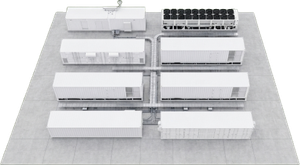
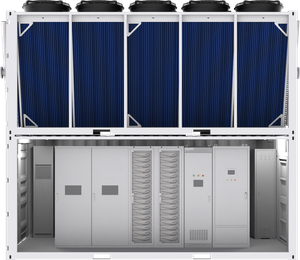
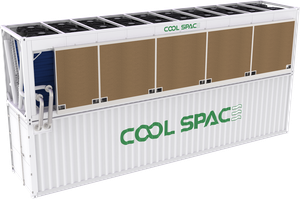
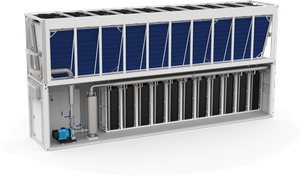
A strong CDU specification for a multi-megawatt project is short on adjectives and long on stated conditions, test methods and responsibilities. If you want a second set of eyes on a draft, talk to a Cool Space engineer about your load profile, or see how our modular systems are arranged in the CoolBase-1080A/W outdoor module and our case studies.
Frequently asked questions
What is the most important parameter in a CDU specification?
There is no single one, but the secondary supply temperature and the approach temperature drive most other choices. Together with the heat load, they fix the heat exchanger size, the flow rate and the dry cooler duty.
Should a CDU specification name a brand or a standard?
It should name performance requirements and test methods, not brands. Referencing recognized guidelines such as ASHRAE classes keeps the specification neutral and verifiable.
How much redundancy does a multi-megawatt CDU need?
It depends on the availability target and on how the load is split across units. Common practice is to define redundancy for pumps and heat exchangers and to state whether a CDU can be isolated for maintenance without reducing hall capacity.
Who should write the acceptance test plan?
The owner or engineer should define the criteria in the tender, and the supplier should propose detailed procedures for approval. That way the tests prove the requirements you actually care about.
References
- Upsite Technologies, "Major Changes to ASHRAE's Fifth Edition of Thermal Guidelines, Part 3: Liquid Cooling Chapter Updates" (summary of ASHRAE TC 9.9 liquid cooling classes)
- Open Compute Project, Liquid-to-liquid CDU test methodology and performance rating (white paper)

 AI Data Centers
 Crypto Infrastructure